 Still Saju
The Five Elements in Korean Astrology: Which One Are You?
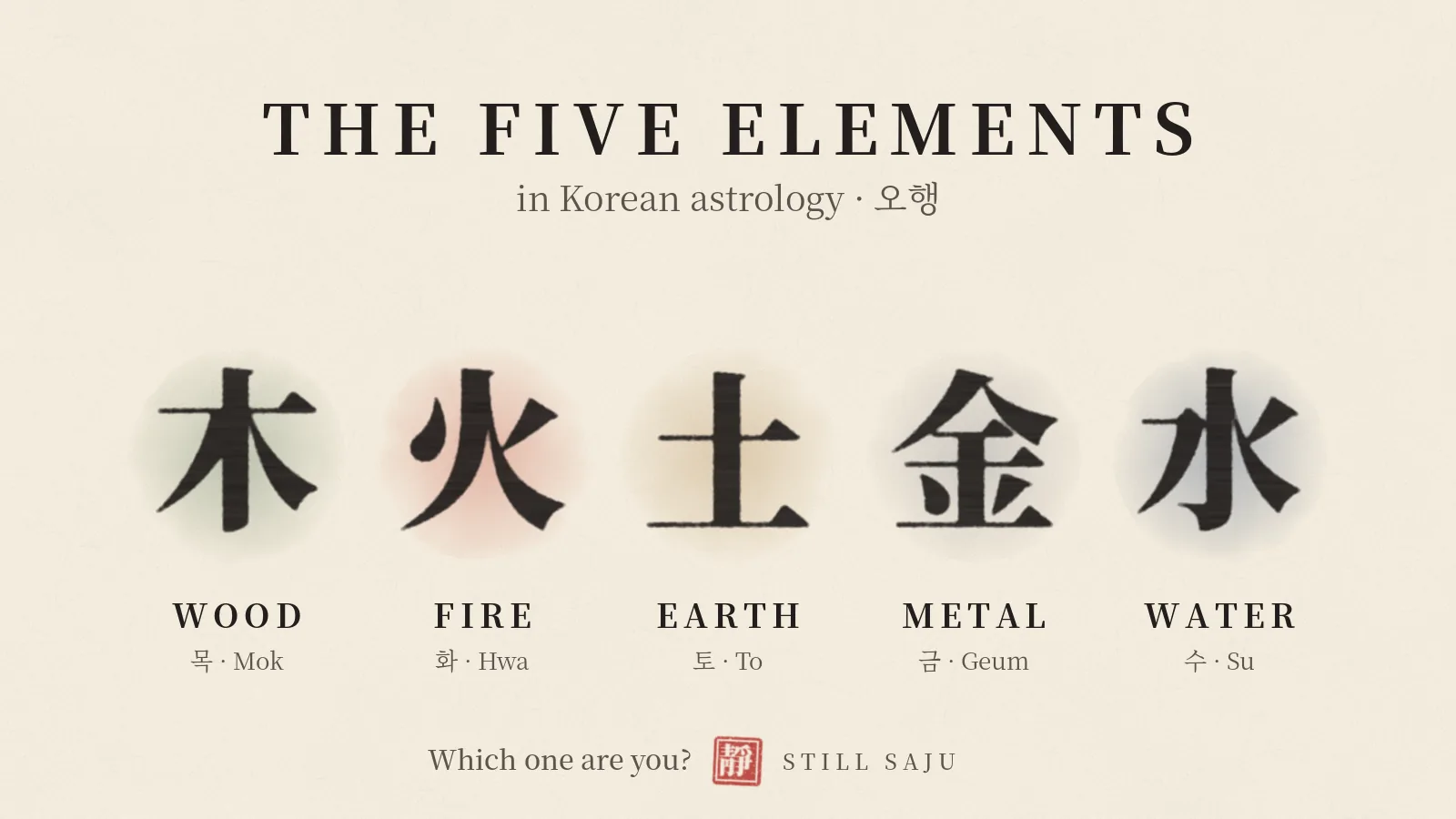
Forget your star sign for a second.
In Korea, when people want to understand themselves (or a new partner, or a new boss), they don't ask "What's your sign?" They look at your saju (사주), the four pillars of your birth. And at the center of every saju chart sits one element that says the most about who you are.
There are only five: Wood, Fire, Earth, Metal, and Water. Read through all five below. Most people know which one is theirs by the second paragraph.
Your element comes from the day you were born
Saju means "four pillars." Your birth year, month, day, and hour each form one pillar, and each pillar holds two characters. That gives you eight characters in total, which is why saju is also called palja (팔자), "the eight characters."
Of those eight, one matters most: the top character of your day pillar. Saju readers call it your Day Master (일간). Think of it as you, the main character. Everything else in the chart describes the world around you and how you move through it.
Every Day Master belongs to one of the five elements. Each element also comes in two versions, yang (outward, bold) and yin (inward, subtle). So a "Water person" might be a vast ocean or a quiet drop of rain. Same element, very different energy.
One thing to know before you read on: your Day Master is not the same as your Chinese zodiac animal. The animal comes from your birth year. Your Day Master comes from your birth day, and it's far more personal.
Wood (목, Mok): the one who keeps growing
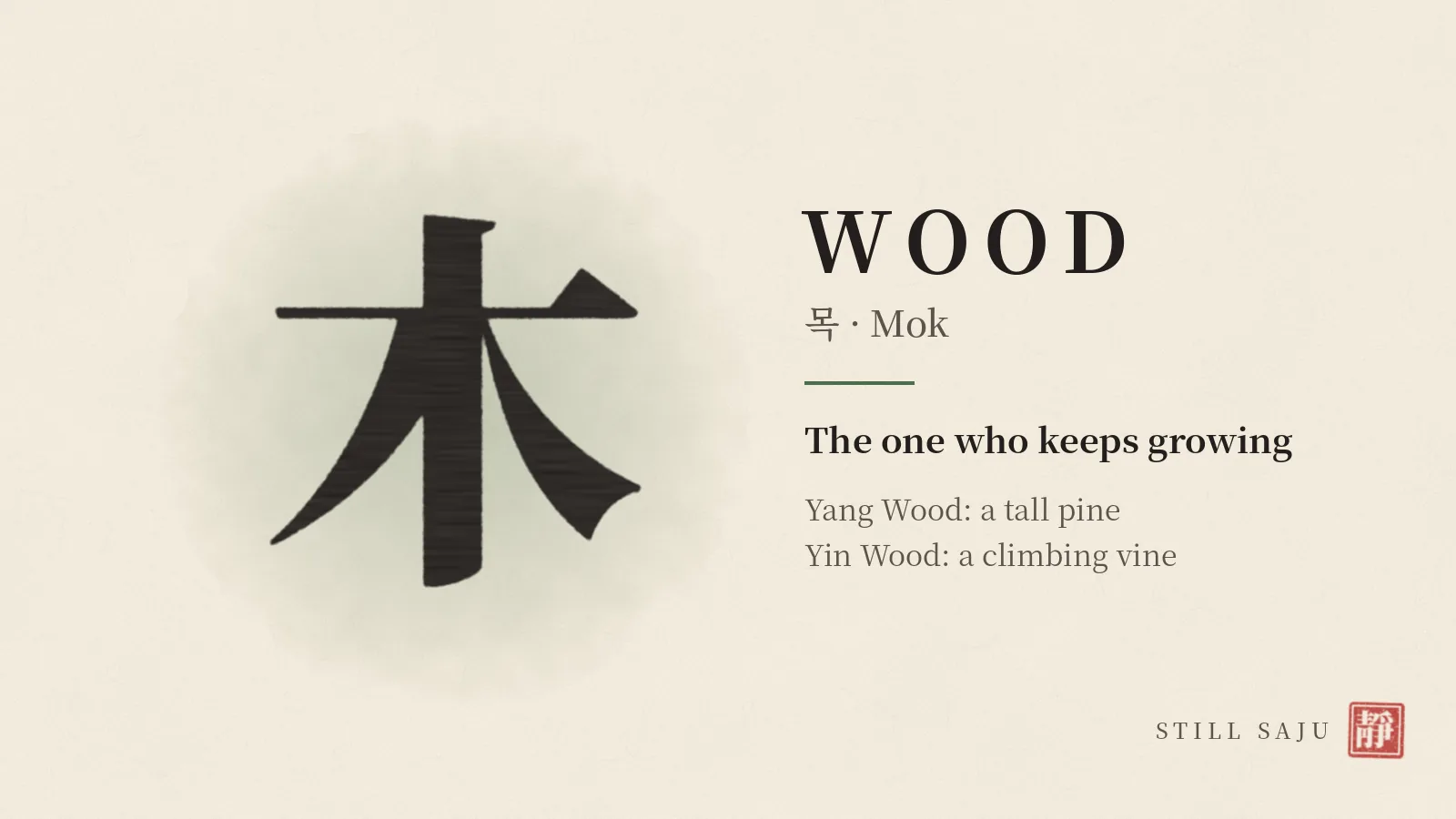
Yang Wood is a tall pine. Yin Wood is a climbing vine.
Wood people start things. New projects, new hobbies, new five-year plans. They believe people can change and grow, including the friend who has let them down three times. They're idealistic, generous with encouragement, and quietly stubborn about what they think is right.
- In love: You want a partner you can grow with, not one who wants you to stay the same. Feeling stuck in a relationship hurts you more than an argument does.
- At work: You're happiest building something from the ground up. Teaching, mentoring, starting a business, anything with a "before" and "after."
- Quiet flaw: You bend for everyone, again and again, until one day you snap all at once. People never see it coming. You did.
Fire (화, Hwa): the one who lights up the room
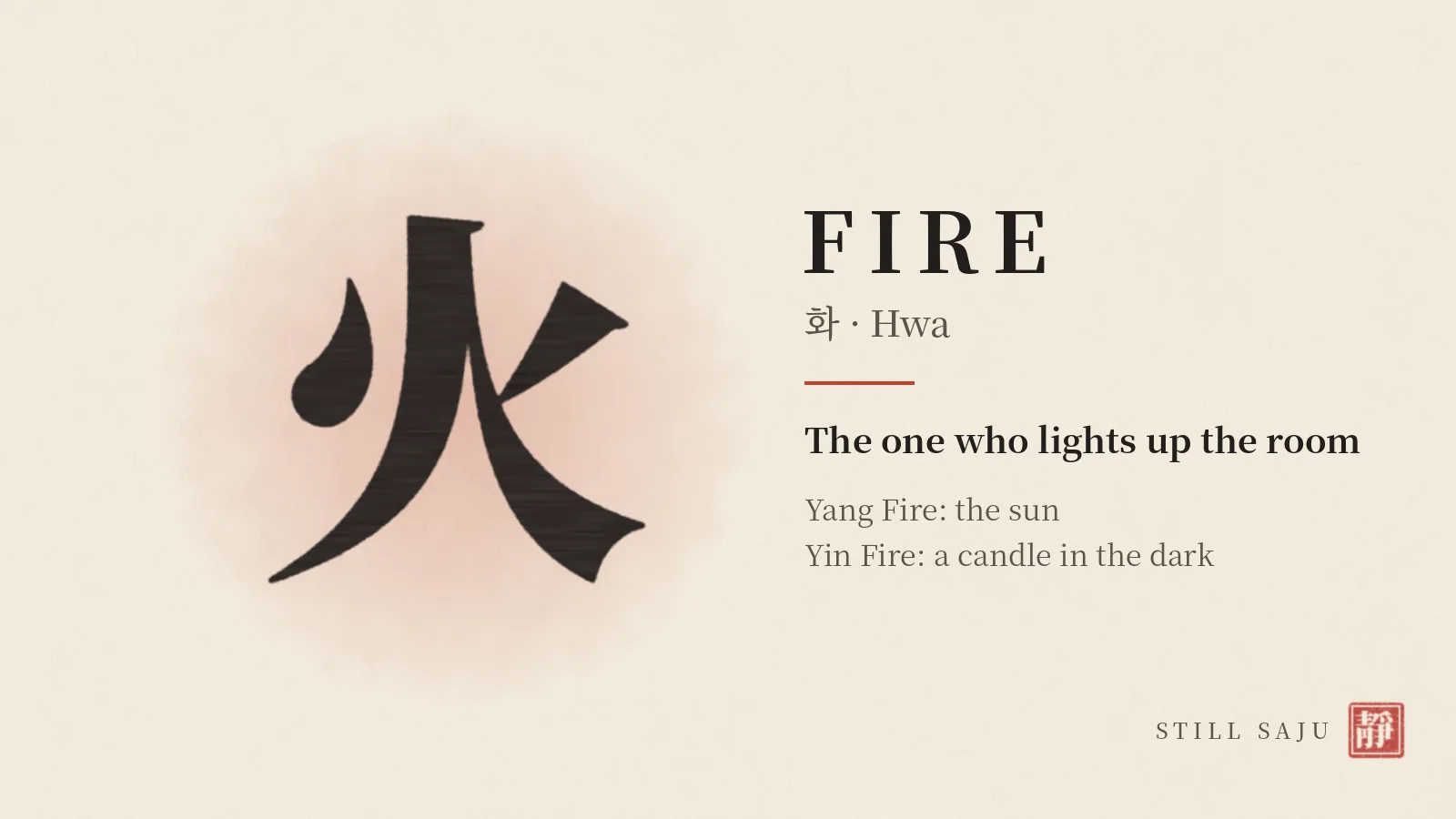
Yang Fire is the sun. Yin Fire is a candle in a dark room.
Fire people walk in and the room gets warmer. They're expressive, funny, and honest to a fault, because hiding what they feel takes more energy than saying it. They feel everything at full volume: joy, anger, excitement, heartbreak. Then they wonder why they're so tired.
- In love: You fall fast and love loudly. Grand gestures come naturally to you, and you need a partner who doesn't flinch at big feelings.
- At work: You shine anywhere there's an audience. Sales, performing, content, leading a team through a hard week.
- Quiet flaw: You give 100% to everyone and forget to keep any for yourself. Burnout doesn't sneak up on you. It walks right in, and you hold the door.
Earth (토, To): the one everyone leans on
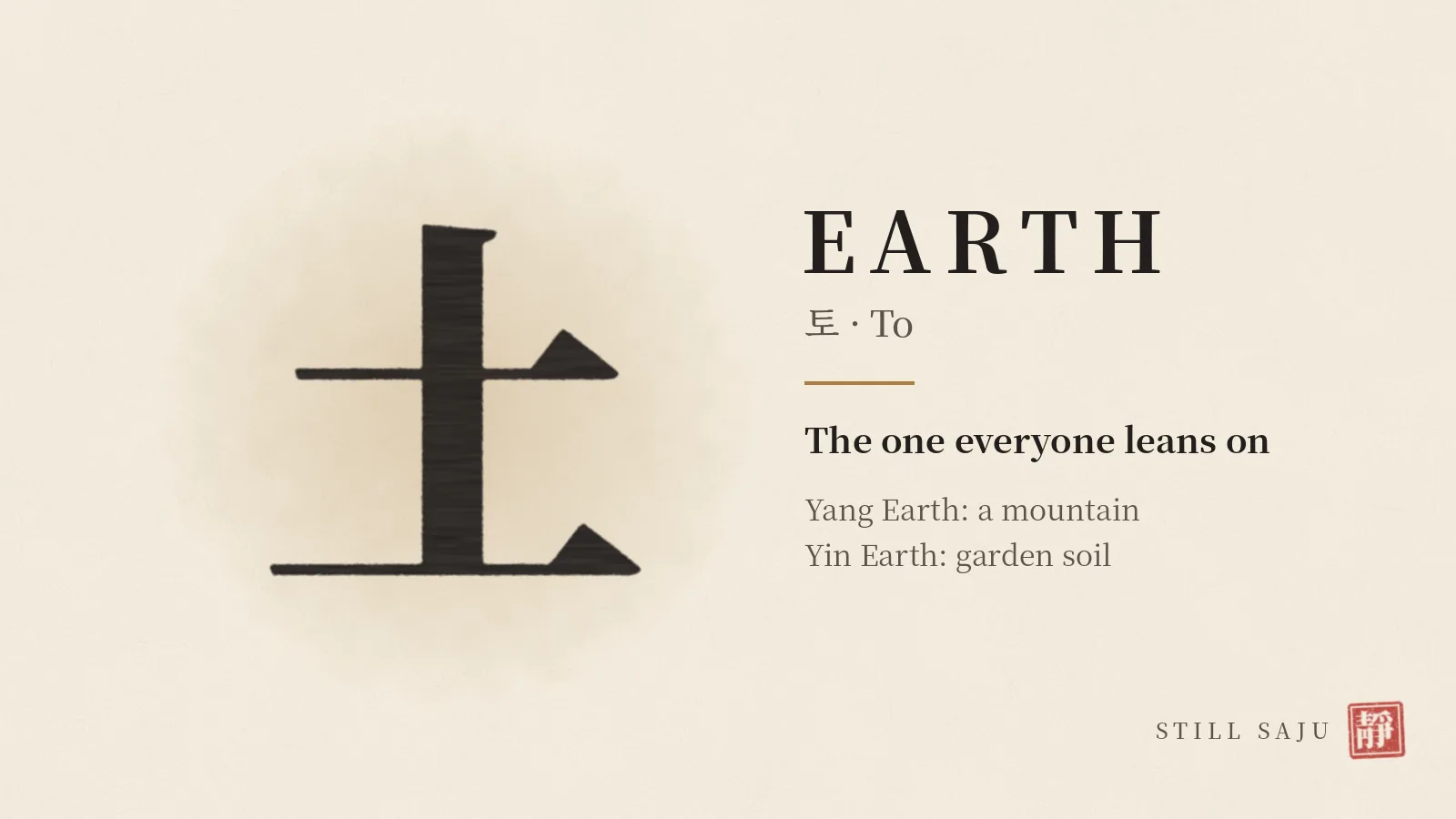
Yang Earth is a mountain. Yin Earth is garden soil.
Earth people are the friend everyone calls in a crisis. They remember birthdays, coffee orders, and something you said in passing in 2019. They're steady, patient, and loyal, and they don't change their minds just because the room did. Being around them feels like exhaling.
- In love: You show love by showing up. Rides to the airport, soup when someone's sick, the same person every year. You want security, not fireworks.
- At work: You're the one who makes things actually run. Operations, finance, healthcare, managing people who'd be lost without you.
- Quiet flaw: You'd rather carry everything yourself than ask for help. And when change finally comes, you dig in your heels long after it was time to move.
Metal (금, Geum): the one with standards
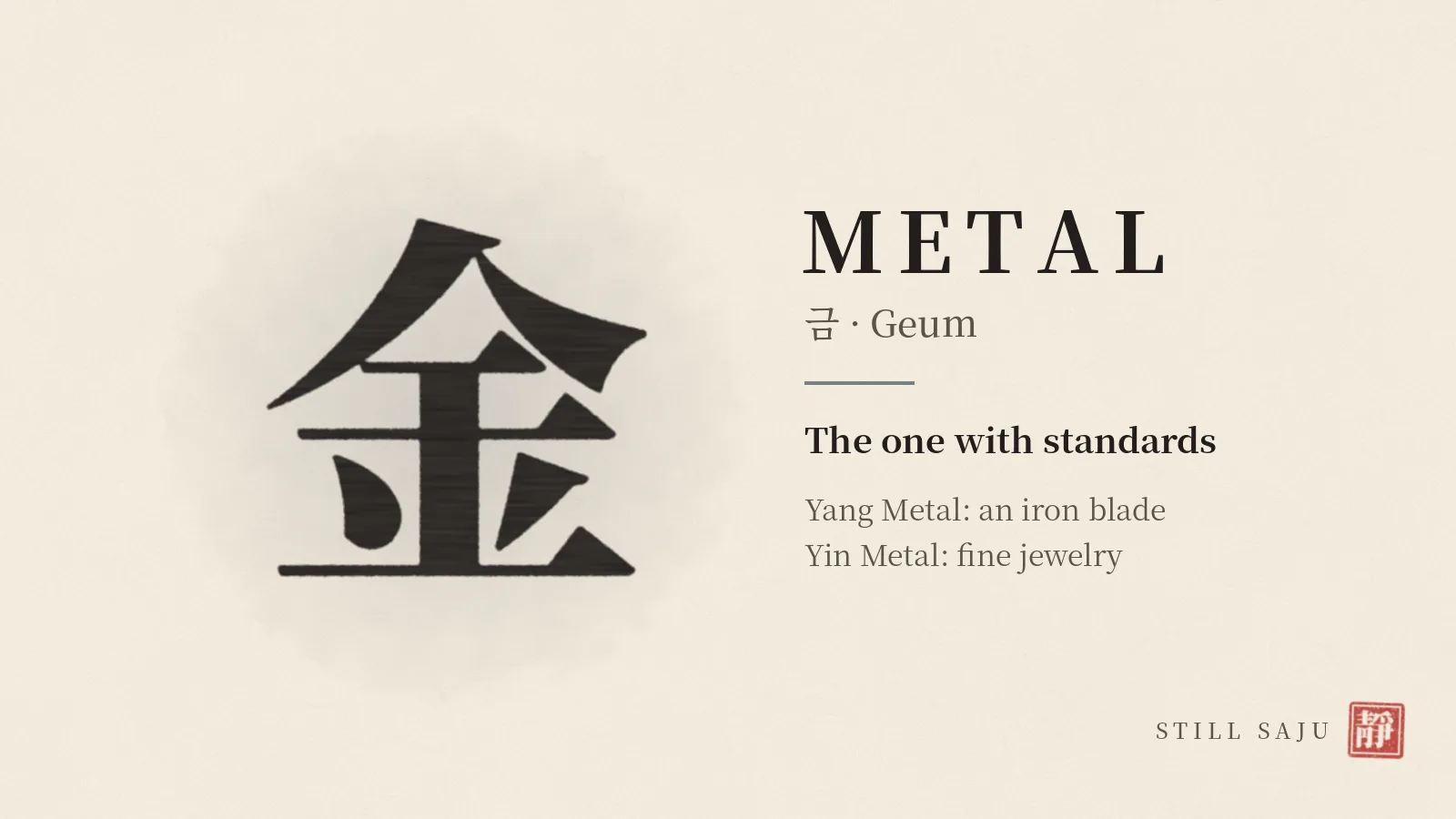
Yang Metal is an iron blade. Yin Metal is a piece of fine jewelry.
Metal people have standards, and they're not lowering them. They're clear, decisive, and fair, with a strong sense of right and wrong. Their "no" is a full sentence. They don't make friends quickly, but once you're in, their loyalty is for life.
- In love: You take commitment seriously and expect the same. Small broken promises bother you more than you let on. Respect matters to you as much as romance.
- At work: You thrive where precision counts. Law, engineering, design, editing, anything where "almost right" isn't good enough.
- Quiet flaw: You're harder on yourself than you are on anyone else. The voice in your head that says "not good enough yet" rarely takes a day off.
Water (수, Su): the one who notices everything
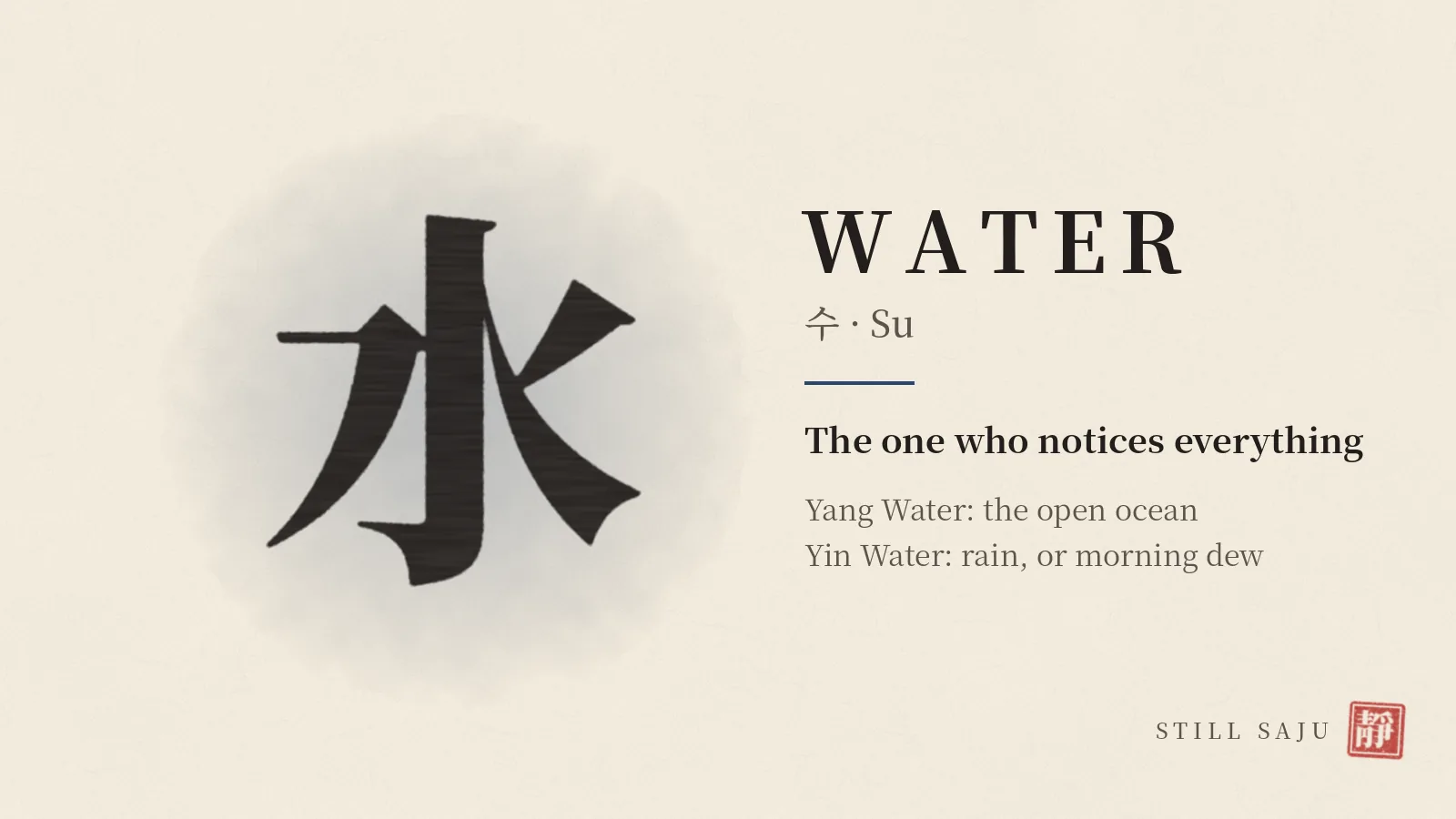
Yang Water is the open ocean. Yin Water is rain, or morning dew.
Water people notice what nobody says out loud. They're intuitive, curious, and adaptable. They can fit into almost any room and read it within minutes. Calm on the surface, very deep underneath. Their best ideas tend to show up at 2 a.m.
- In love: You need someone who's interesting to talk to for years, not just attractive for a season. You open up slowly, and only to people who've earned it.
- At work: You do well where thinking is the job. Research, strategy, writing, psychology, anything that rewards seeing patterns before others do.
- Quiet flaw: People think they know you. They don't. You keep so much inside that even the people closest to you sometimes feel shut out.
How the five elements work together
No element works alone. In saju, the five elements move in two cycles, and those cycles explain a lot about why some people energize you and others wear you out.
In the generating cycle (상생, sangsaeng), each element feeds the next: Wood fuels Fire, Fire leaves ash that becomes Earth, Earth holds Metal ore, Metal gathers dew, and Water feeds Wood. In the controlling cycle (상극, sanggeuk), each element keeps another in check: Wood's roots break up Earth, Earth dams Water, Water puts out Fire, Fire melts Metal, and Metal cuts Wood.
Neither cycle is good or bad. A little control is what keeps a fire from burning the house down. This is also the starting point of saju compatibility: a Water person and a Wood person tend to feel easy together, while a Fire person and a Metal person often push each other hard, sometimes in exactly the way they need.
So which one are you?
If you recognized yourself somewhere above, that's a good start. But your real element doesn't come from a quiz. It comes from a calendar.
Finding your Day Master means converting your birth date into the traditional Korean calendar of stems and branches. It's not something you can do in your head. The good news is you only need your date of birth. Your birth time adds the fourth pillar and fills in the rest of the chart, but it doesn't change your Day Master. (One exception: if you were born close to midnight, the exact time can decide which day you belong to.)
Our free saju calculator opens in January 2027. Enter your birthday and you'll see your Day Master, your full four-pillar chart, and a short reading of what it says about you.
Want to know the day it opens? Send us a note and we'll email you once.
Notify meUntil then, send this to the friend you've always suspected is a Fire type. You're probably right.
Frequently asked questions
Is saju the same as Chinese astrology or BaZi?
They share the same roots. BaZi ("eight characters") is the Chinese name for the four pillars system. Korea has used it for centuries and built its own tradition of reading it, which is what saju is today.
Can I have more than one element?
Yes. Your chart has eight characters, and most people have three or four elements in it. Your Day Master is your core, but the balance of the others shapes how that core shows up. Some people are missing an element entirely, which says a lot too.
Do I need my birth time?
Not for your Day Master. You only need it for the hour pillar, which adds detail to the full reading.
Is one element better than the others?
No. Every element has gifts and blind spots. In saju, what matters is balance, not which element you got.
Is saju real?
Saju isn't science, and Still Saju is for entertainment and self-reflection. But millions of people in Korea use it the way others use journaling or personality tests: as a calm, structured way to think about who they are and what they want next.
For entertainment and self-reflection only.